Giving birth at Saint Mary's Hospital, Oxford Road
A guide from The Nest Collective
Saint Mary's Oxford Road Campus is Manchester's specialist hospital for women, babies and families. It sits on the same site as Manchester Royal Infirmary (MRI) in the city centre, and it's the hospital most people in Greater Manchester are referred to when a pregnancy becomes complex or high-risk. It's also one of the options for low-risk pregnancies - though it may not always be the first place your midwife suggests.
Here's what's useful to know before you decide, and what to expect if you birth there.
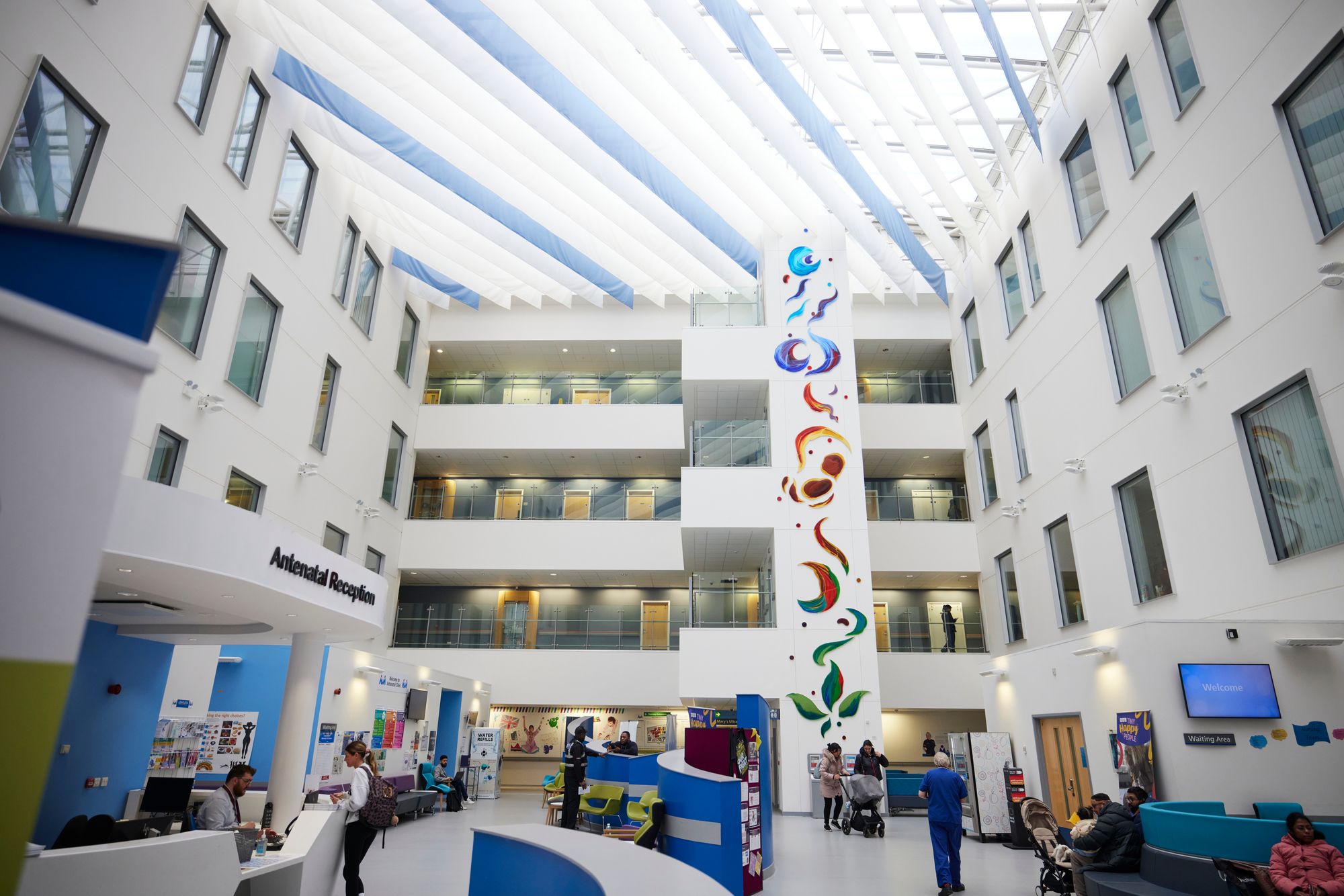
Saint Mary's Oxford Road Campus, Manchester
What kind of hospital is it?
Saint Mary's is one of three sites for maternity services under Manchester University NHS Foundation Trust (MFT). The Oxford Road site has a central delivery unit with 14 birthing rooms, one room with a birthing pool, adjacent maternity theatres, four enhanced maternal care rooms, induction of labour beds, a triage unit with 10 beds, post and antenatal wards, a fetal medicine unit and a maternal medicine service.
It's also the regional referral centre. If your pregnancy develops complications - pre-eclampsia, gestational diabetes, a high-risk presentation - your chances of ending up at Saint Mary's Oxford Road are higher. For this reason, many people choose it proactively: if something goes wrong, you're already there.
That same fact cuts the other way. Local doctors sometimes advise people with an uncomplicated pregnancy not to pick Oxford Road as their first choice, because this is where Greater Manchester's most complex cases go - and a straightforward labour can feel less of a priority on a very busy unit. In any case, you are not locked in. If you start at a closer hospital and the pregnancy becomes more complicated, you can be transferred to Saint Mary's later. Parents who have made that move often speak highly of the specialist teams once they arrive.
The birthing pool
There is one birthing pool room at Oxford Road.
This sounds limiting, and it can be - but it's important understanding how it works in practice. Because Saint Mary's receives a higher proportion of referred, higher-risk pregnancies, many people who arrive are not planning a pool birth. The building and birthing suites themselves are described as really lovely, but the hospital is very busy. Your chances of getting the pool room depend on whether it's occupied when you arrive, and there's no way to guarantee it in advance.
If the pool is available and you want it, ask clearly and early. One parent we spoke to was initially placed in a standard suite and asked to be moved to the pool room - they were moved without any issue.
The antenatal ward
If you come in before established labour, you'll be admitted to the antenatal ward. Saint Mary's policy is that a vaginal examination is required for admission to the antenatal ward. You have the legal right to decline this as no procedure can be carried out without your consent, regardless of hospital policy. If you want to discuss this in advance, raise it with your community midwife and note your preference in your birth plan.
Pain relief like gas and air is not routinely used or provided here. Pain relief available at this stage is oral - codeine and paracetamol. (Note: paracetamol is a prostaglandin inhibitor - and prostaglandins play a key role in cervical ripening and labour progress. There is a plausible theory that routine paracetamol use during early labour may slow progress. This is worth raising with your midwife before making a decision. Read more: sarawickham.com )
"I wish I hadn't taken the codeine as it slowed my early labour right down and delayed everything. I also wish I hadn't gone to the hospital so early and maybe let my waters break at home. But it was my first and I was scared!"
If it's your first baby, you may spend considerably longer on the antenatal ward than you expect before being transferred to the delivery suite.
"We were in the antenatal ward for three days before being transferred to delivery. I don't think me or my husband really realised how long it could take or thought about best use and preservation of his reserves."
On the antenatal ward one birth partner is welcome to visit from 6am until midnight. An additional two visitors (and siblings of unborn) are welcome to visit from 10am to 8pm.
On Triage/Delivery Suite/Birth Centre two birth partners are welcome at all times.
On the Postnatal Ward/Enhanced Recovery one birth partner is welcome from 6am until midnight. An additional two visitors (and siblings of newborn) are welcome to visit from 10am to 8pm.
We were told that in practice this is not consistently enforced. Other patients' partners may be staying, which could affect your rest.
The delivery suite
Saint Mary's recommends intermittent auscultation where possible as it allows more mobility than continuous monitoring. However, continuous monitoring is used when clinically necessary. If wireless monitoring equipment is unavailable - which can happen during busy periods - your mobility will be limited.
The hospital is at its busiest in summer months. Staffing and resources, including monitoring equipment, can be stretched at peak times.
"We gave birth during their busiest time of year - June. When we finally got to the delivery ward, we couldn't request any wireless monitoring as they had run out."
I wish I'd known...
"that they have a limit of time that you’re allowed to do the pushing stage for, before they say you need to move on to forceps etc."
Afterwards
The postnatal ward is as busy as the rest of the hospital. One birth partner is welcome from 6am until midnight; extra visitors (and siblings) 10am to 8pm.
Because Oxford Road looks after so many families, bed space is tight. Some parents are discharged while their baby stays - for example if the baby is on the neonatal unit. Ask on the ward what the usual pattern is, and have a plan for how you would get back in if that happens.
"They deal with so many mums at Saint Mary's that bed space is precious. I may end up being discharged before baby."
Getting there - a practical note
The drop-off point for the maternity unit is not always obvious. If you haven't been before, we'd strongly recommend doing a dry run in advance - knowing where to park, where to go, and how long it takes matters enormously when you're in labour. Time that run at rush hour if that's when you might travel. From east Manchester or Tameside, Oxford Road is often 25-45 minutes by car; from south Manchester it can still snarl at peak times. Saint Mary's also has a virtual tour of the maternity unit on YouTube, which is a useful watch if you want to see the wards and delivery suite before you arrive.
If your community midwife sits with a different trust (Tameside, Stockport, Salford and so on), ask early how notes, scan results and triage calls will be shared. Parents whose care straddles two trusts sometimes find information does not follow them as smoothly as it should.
Two multi-storey car parks serve the site: Grafton Street (north east) and Hathersage Road (south west), both pay-on-foot.
Parking is free for relatives of long-stay patients - if your birth partner is with you for several days on the antenatal ward, it's worth asking the ward team about the concession before the bill adds up. Disabled badge holders also park free.
There's a drop-off area directly outside with free 30-minute bays opposite the main entrance.
Full details and a parking map: mft.nhs.uk
"We never figured out how to get to the drop-off point. We parked at Hathersage car park and walked to the ward with my hospital bag and suitcase. If I had my time again I think I would have made the time to do a dry run."
Useful numbers
- Oxford Road Triage (urgent, 24/7): 0161 276 6567
- Oxford Road Community Midwives (non-urgent, 8am–5pm): 0161 276 6246
- For traffic: try to arrive and be discharged outside rush hour - the roads around MRI can be slow
Hospital antenatal classes
Saint Mary's runs a free five-week course called Your Birth, Your Baby. It is online on weekday evenings, 6–8pm, on Microsoft Teams and open if you are having your baby with them (Oxford Road, Wythenshawe or North Manchester). Ask your midwife to refer you, or email parent.classes@mft.nhs.uk. Details and how to join: mft.nhs.uk antenatal classes.
If you would rather do something in person, our course is five Thursday evenings South Manchester.
What parents say
The consistent picture from parents who have birthed at Saint Mary's Oxford Road is a split one.
Most people who have given birth there describe good levels of care, with babies and mothers kept safe. The building and birthing suites are described as really lovely. But the hospital is described as very busy, with limited continuity of care and appointments that don't always run to time.
Staff are frequently described as kind and well-meaning. The frustration parents more often describe is systemic rather than individual.
"The midwives and staff were lovely but I felt the resources and facilities were limited. There also seemed a focus on box ticking and checklists rather than actually listening to what the patient needed or wanted in the moment."
"The midwives we had were very supportive of hypnobirthing and gave us a lot of space. Everyone was very respectful and gave us a lot of room to make our own decisions and give consent."
"I gave birth at Saint Mary's in March and felt cared for, listened to, and at no point rushed out of the hospital. I would go back."
"I had a high-risk pregnancy and birth at Saint Mary's and genuinely couldn't fault them. I now live an hour away and will still be going there for the next baby."
Is it right for you?
Saint Mary's Oxford Road makes sense if:
- You have a complex or higher-risk pregnancy and want to be where the specialists are
- You want access to the highest level of neonatal care on site if needed
- You're being referred there by your care team
- It's your closest hospital and a shorter journey is important to you - particularly relevant if you live in central or south Manchester
It may not be the first choice if:
- You're low-risk, your pregnancy is straightforward, and a closer obstetric unit would get you there in labour more calmly
- You want a calmer, more midwifery-led environment - in which case the Manchester Birth Centre at Wythenshawe or a home birth may suit you better
- You want a strong chance of a pool birth
- Continuity of care matters a great deal to you
You can change your planned place of birth during pregnancy. A closer hospital first, with a transfer to Oxford Road if you need specialists, is a path plenty of people take.
Whatever you decide, the most important thing is that you know your options. You are entitled to discuss your preferred place of birth with your community midwife, and to ask questions about what each setting offers.
This blog post was prepared by The Nest Collective using publicly available information, CQC inspection reports, and anonymous experiences shared by parents in our community and in public discussion. It is not a substitute for individual midwifery advice. If you have questions about your own care, speak directly with your midwife or consultant.
We are building a series of guides on giving birth at Manchester's hospitals. If you have given birth at Saint Mary's Oxford Road and would like to share your experience anonymously, get in touch at nestcollective.manchester@gmail.com.